


Artificial Intelligence (AI) has moved beyond imagination — it now powers the systems, services, and innovations that define modern life. In India, this transformation is happening faster than ever, driven by forward-thinking entrepreneurs and bold government missions.
From AI-powered healthcare diagnostics to adaptive education platforms and data-driven fintech, Indian innovators are proving that technology can serve both progress and inclusion. Supported by programs like Digital India and the IndiaAI Mission (2024), the country is emerging as a global powerhouse for responsible, human-centric AI.
This article explores how startups and policies are shaping India’s AI future — transforming industries, addressing challenges, and leading a new era of intelligent innovation.
Top AI Startups Revolutionizing India’s Tech Landscape
Innovation at the Core
India’s AI ecosystem is thriving. Startups such as Fractal Analytics, Mad Street Den, SigTuple , Yellow.ai, and Haptik are redefining how technology interacts with people and industries.
Fractal Analytics leads enterprise analytics with automation and data science. Mad Street Den’s computer vision technology personalizes retail experiences, while SigTuple applies AI to medical imaging for faster, more accurate diagnostics. Yellow.ai and Haptik are transforming customer engagement through conversational AI and virtual assistants, setting benchmarks in intelligent communication.
Together, these AI startups in India represent a movement — one that merges innovation with empathy to make artificial intelligence more scalable, efficient, and deeply human.
AI in Healthcare: When Technology Saves Lives
The Human Side of AI
In healthcare, AI’s impact is truly life-changing. Startups such as Qure.ai, Niramai, and Tricog are leading the transformation by integrating machine learning into medical diagnostics and care delivery.
Qure.ai uses deep learning to interpret X-rays and CT scans, accelerating diagnosis and improving accuracy. Niramai’s AI-powered thermal imaging enables early breast cancer detection without invasive procedures. Tricog’s cloud-based ECG interpretation platform brings cardiac diagnostics to rural and remote areas, bridging long-standing healthcare access gaps.
By combining predictive analytics, telemedicine, and data-driven diagnosis, AI in healthcare is making treatment faster, more affordable, and more equitable — proving that technology can save lives.
AI in Education: Smarter Learning for the Next Generation
Reimagining Classrooms with Data and AI
India’s education revolution is now powered by artificial intelligence. Edtech platforms such as Byju’s, Embibe, and Leverage Edu are integrating AI in education to personalize learning experiences for millions of students.
Byju’s leverages behavior analytics to design adaptive lessons. Embibe’s AI algorithms deliver real-time feedback to help students improve. Leverage Edu applies intelligent matchmaking to guide students toward ideal academic institutions and career paths.
Through these innovations, education is becoming more inclusive, dynamic, and accessible — enabling teachers to tailor learning to every student’s pace and potential.
AI in FinTech: Powering India’s Digital Economy
Smart Finance, Simplified
The fusion of AI in fintech and financial inclusion is transforming how Indians manage, save, and invest. Startups such as Razorpay, Cred, and Paytm are embedding AI into financial systems to enhance security, detect fraud, and expand access to credit.
Razorpay’s algorithms assess payment risks in real time, while Cred uses intelligent models to reward responsible credit behavior. Paytm applies AI to evaluate customer creditworthiness, offering tailored lending solutions to underserved users.
By merging automation with analytics, AI in fintech is fueling the Digital India vision — building a financial ecosystem that is faster, safer, and more inclusive.
Government Policies and Initiatives: Enabling the AI Revolution
Policy Support for Innovation
The Indian government has been instrumental in accelerating AI adoption through visionary frameworks and investments. The Digital India Mission has laid the groundwork for AI integration across public services. The IndiaAI Mission (2024) — a ₹10,000 crore initiative — focuses on AI infrastructure, research, and workforce development.
Policies like NITI Aayog’s National AI Strategy promote sector-wide adoption of AI in healthcare, education, and agriculture. Meanwhile, Startup India and the Atal Innovation Mission nurture AI-driven ventures through funding, incubation, and mentorship.
These efforts have positioned India as an “AI Garage for the World,” developing scalable technologies that address both domestic and global needs.
Emerging AI Trends
Where the Future Is Headed
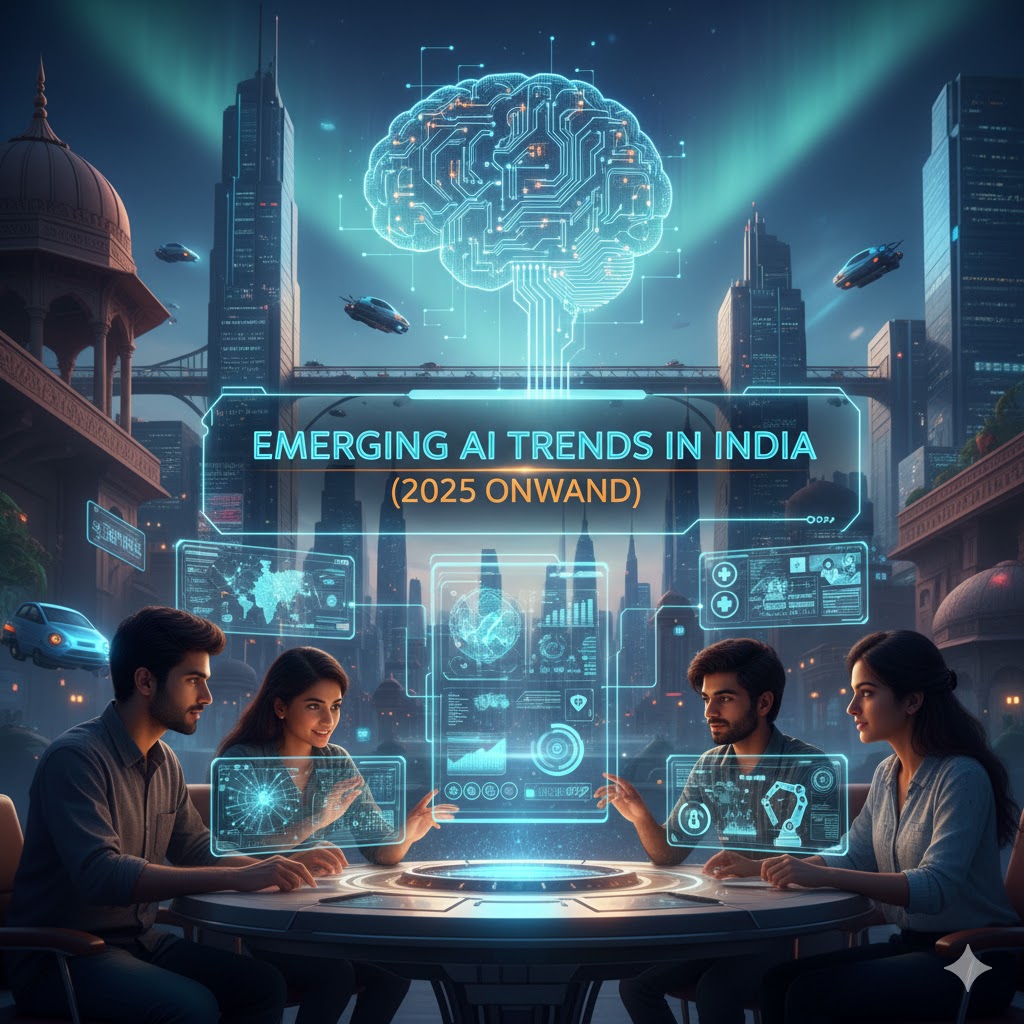
As India looks beyond 2025, several transformative artificial intelligence trends are emerging. Generative AI startups like Sarvam AI and Krutrim are creating Indian-language large language models, democratizing AI access for millions. In robotics, GreyOrange leads automation in logistics and supply chains.
The growth of Edge AI — processing data directly on devices — enhances both privacy and speed. AI-driven governance is becoming integral to smart cities, traffic systems, and citizen services.
According to IndiaAI.gov.in (2025), India’s AI sector is expanding at a 25–35% CAGR and could reach $17 billion by 2027 — a testament to the country’s innovation momentum.
Challenges on the Road Ahead
Building Trust and Ethics in AI
While progress is accelerating, India’s AI journey faces hurdles. Ensuring compliance with the Digital Personal Data Protection Act (2023) is critical for data privacy and public trust. Transparency and explainability in AI systems must improve, especially in sectors where human lives or finances are at stake.
Job displacement due to automation underscores the importance of nationwide reskilling programs, and smaller startups need better access to high-performance computing infrastructure. Balancing innovation with ethical AI practices will be essential to ensure sustainable and responsible growth.
Future Outlook (2025–2030)
The Next Leap
By 2030, India is poised to emerge as a global AI innovation hub, leading with responsibility and inclusion. Collaboration between startups, academia, and government agencies will deepen, enabling the creation of more explainable and ethical AI systems.
As industries embrace automation, India’s focus will remain on ensuring AI complements human intelligence — empowering creativity, productivity, and empathy. With sustained investment and strategic governance, AI will drive both economic development and social transformation.
Conclusion
Artificial Intelligence in India is not merely a technological evolution — it is a human revolution. Indian startups are fusing innovation with compassion, developing systems that learn, adapt, and serve human needs. Supported by visionary government policies and an entrepreneurial spirit, India stands at the threshold of a future where AI meets the human mind.
This convergence symbolizes progress that amplifies human intelligence, creativity, and care — crafting a future that is both technologically advanced and profoundly humane.
When AI Meets the Human Mind
How Indian Startups Are Redefining Technology's Future
It refers to the convergence of artificial intelligence and human creativity — where machines enhance, rather than replace, human decision-making, innovation, and emotional intelligence. This synergy creates a powerful partnership where AI augments human capabilities, leading to more innovative solutions and breakthroughs.
Indian startups are integrating AI into real-world solutions — from healthcare and education to fintech and agriculture — making technology more accessible, ethical, and human-centered. They're focusing on solving local problems with global relevance, creating AI solutions that are both scalable and culturally contextual.
Companies like Fractal Analytics, Mad Street Den, Yellow.ai, Qure.ai, and Genei are pioneering AI solutions that combine deep tech with human insight. These startups are making significant strides in computer vision, natural language processing, and predictive analytics.
AI helps humans by automating repetitive tasks, analyzing vast datasets, and providing insights that empower creative problem-solving and better strategic thinking. It acts as a collaborative tool that extends human cognitive abilities, allowing professionals to focus on higher-value tasks that require emotional intelligence and creative thinking.
Sectors like healthcare, education, finance, logistics, and agriculture are experiencing massive transformations through AI-driven automation and predictive analytics. In healthcare, AI is improving diagnostics; in agriculture, it's optimizing crop yields; and in finance, it's enhancing fraud detection and customer service.
Concerns include data privacy, algorithmic bias, and overreliance on automation — all of which demand human oversight and transparent governance. There are also concerns about job displacement, the potential for manipulation through personalized content, and the need to ensure AI systems align with human values and ethical standards.
Startups can adopt a "human-in-the-loop" approach, ensuring that ethical frameworks, empathy, and inclusivity guide AI development and deployment. This involves diverse teams in development, regular ethical audits, transparent AI systems, and designing AI that augments rather than replaces human capabilities.
The future points toward augmented intelligence, where AI amplifies human skills — creating smarter jobs, ethical innovation, and a more sustainable tech ecosystem. We'll see more symbiotic relationships between humans and AI, with technology handling data-intensive tasks while humans focus on strategy, creativity, and ethical oversight.
No matching FAQs found
Try searching with different keywords