

AI vs Human Creativity in 2025, Can a Machine Really Think Like Human?
Artificial Intelligence is redefining how we think about creativity. From writing blog posts to designing visuals and composing music, AI is stepping into spaces once ruled by human imagination.
But that raises a fascinating question — in the debate of AI vs Human Creativity, can machines truly think like humans, or are they just imitating creativity through clever algorithms?
Let’s dive into how AI and human creativity differ, and how they might just work better together than apart.
AI: Creating or Just Calculating?
Forget the spreadsheets and data forecasts, Artificial Intelligence has moved far beyond number crunching.
Today, tools like ChatGPT, Midjourney, and DALL·E are writing poetry, composing music, and creating stunning visuals. These tools generate results so original, they blur the line between technology and art, simulating what was once thought to be a uniquely human ability: creativity.
Generative AI Can Augment Human Creativity
But here’s the real question:
When AI creates something beautiful, is it truly being creative, or is it just following complex patterns? The essence of AI vs Human Creativity lies in that very mystery — calculation versus inspiration.
Understanding Creativity: The Human Element
What makes human creativity so special? It’s more than just coming up with new ideas, it’s about emotion, intuition, and experience working together.
When an artist paints, their brush captures not just an image but a feeling, a moment of emotion or memory. Human creativity connects unrelated ideas, finds meaning in chaos, and sees beauty in imperfection.
We don’t just process data; we feel it.
That emotional depth allows us to create art, stories, and designs that resonate — something AI, for all its brilliance, still struggles to achieve. This is the heart of AI vs Human Creativity: logic versus emotion, replication versus feeling.
How AI “Creates”, The Algorithmic Approach
AI doesn’t think or imagine like humans do. Instead, it learns from massive datasets and predicts what comes next — whether it’s a sentence, melody, or image.
This process, powered by neural networks, looks creative, but it’s actually a sophisticated form of pattern recognition.
While AI can produce impressive results, it doesn’t truly understand meaning or emotion. That deeper, emotional part of creativity still belongs to us — reinforcing why AI vs Human Creativity is not just a technical debate, but a philosophical one.
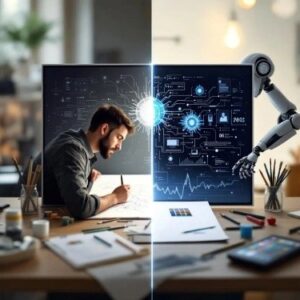
AI vs Human Creativity: A Partnership, Not a Competition
So, who’s more creative, humans or AI?
Maybe that’s the wrong question.
Humans create from emotion, experience, and deep imagination. Our stories, songs, and designs carry personal meaning, shaped by joy, pain, and curiosity that no algorithm can replicate.
AI excels in speed, efficiency, and precision. It can process vast data, generate thousands of ideas, and help creators brainstorm faster than ever.
Instead of viewing it as a contest, the future of creativity lies in collaboration.
AI brings scale and precision; humans bring emotion and originality.
That difference, the why behind creation, is what defines true artistry.
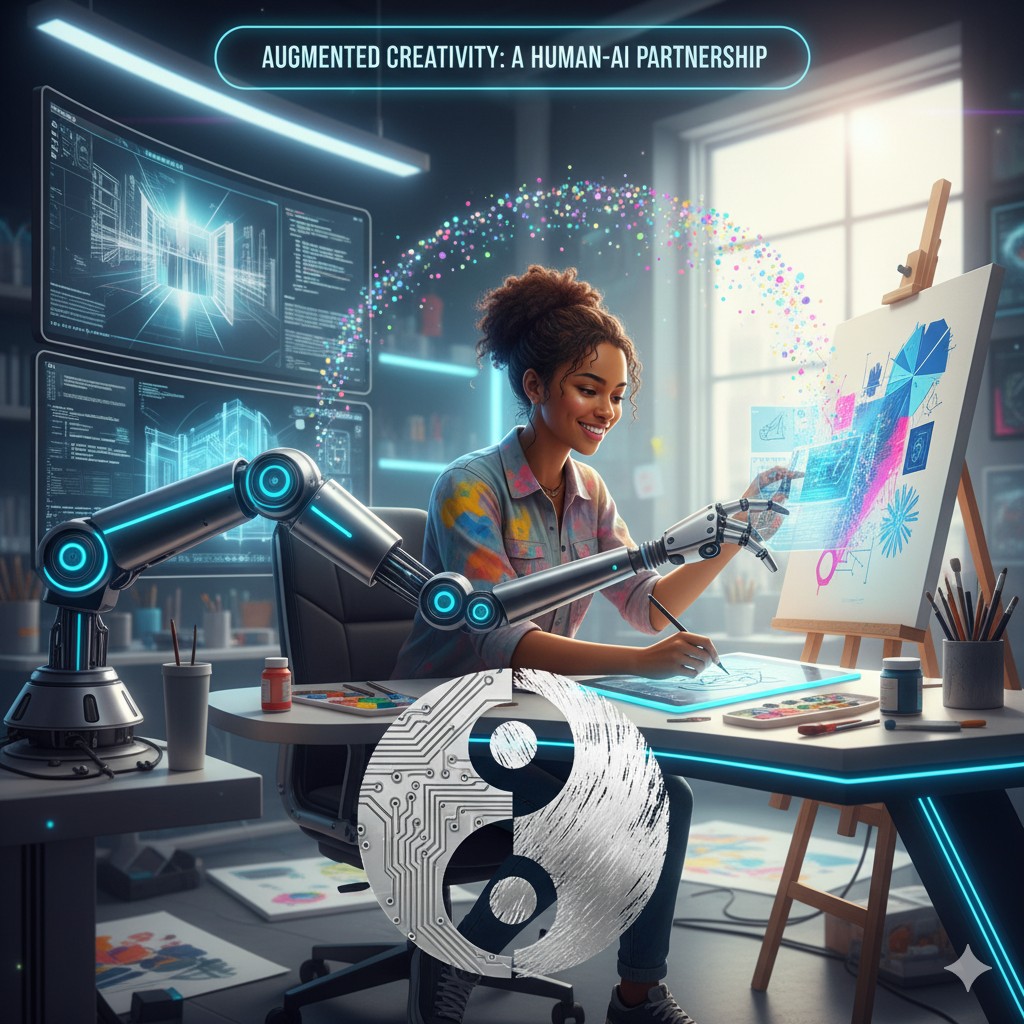
Augmented Creativity: The Human-AI Partnership
It’s not humans vs AI, it’s humans and AI.
The real magic happens when both work together.
AI isn’t here to replace creativity, it’s here to amplify it. In design, marketing, and entertainment, AI helps creators brainstorm, explore new ideas, and bring visions to life faster than ever before.
Example: Brands like Coca-Cola have used AI-generated art in global campaigns, while musicians are using AI to remix sounds and explore new genres.
Humans add emotion and meaning; AI adds speed and possibility. Together, we’re building a new creative frontier, one where technology enhances human imagination instead of replacing it.
Ethical and Philosophical Questions
As AI evolves, it also raises deep ethical and philosophical questions:
Ownership & Authorship: Who owns something made by AI, the user, the company, or the machine? Can an algorithm truly be called an “author”?
Originality vs. Copying: AI learns from millions of human-made works. So where’s the line between inspiration and imitation?
Consciousness: If AI starts showing emotions, is it real, or just an illusion of awareness?
These questions remind us that creativity isn’t only about what we create, but why we create, the emotions, stories, and humanity behind every idea.
Can Machines Truly Think Like Human?
At the end of the day, machines can simulate thinking, but they don’t experience it like we do.
AI can write stories, paint portraits, and compose songs, but it doesn’t feel joy, curiosity, or inspiration.
AI might become a mirror reflecting our own ingenuity, but the spark of imagination, that leap from logic to inspiration, remains uniquely human.
As we move forward, AI shouldn’t replace imagination, it should amplify it.
When humans and machines work together, we can push the boundaries of what’s possible, blending emotional depth with AI’s endless capacity for ideas.
💡 What do you think, can machines ever truly be creative?
Share your thoughts in the comments below or explore more stories on AI Shala, where technology meets human imagination.
Questions & Answers — AI vs Human Creativity
AI can simulate aspects of human thought, but it doesn’t truly “think.” It processes data and predicts patterns without understanding emotion, context, or experience. Human thinking involves consciousness and feelings — things no machine has yet achieved.
AI generates art, music, and writing by analyzing existing data and combining patterns. While the results may seem original, AI doesn’t feel inspiration or emotion. It imitates creativity through algorithms, while humans create through emotion and meaning.
Human creativity is emotional, intuitive, and shaped by experience. It connects ideas in personal, meaningful ways. AI’s creativity, however, is data-driven and based on learned patterns. It can produce impressive outputs but lacks true understanding or intent.
Yes! The most powerful outcomes happen when humans and AI collaborate. AI offers speed, precision, and endless possibilities; humans bring emotion, imagination, and storytelling. Together, they create “augmented creativity” — a new frontier in art and innovation.
Key questions include authorship, ownership, and originality. If an AI creates art trained on human work, who owns it? Can a machine be an author? These issues remind us that creativity isn’t just about the result — it’s about the human story behind it.